
Sales Call Sentiment Analysis: How AI Reads Customer Emotion to Predict Deal Outcomes
Author: Moeez Ullah Published Date: September 10, 2026
The Gap Between What's Said and What's Meant
A prospect can say "this looks great, let me think about it" in two completely different ways — one genuinely enthusiastic, one politely closing the door. The words on a transcript are identical. What differs is tone, pacing, and hesitation, none of which show up if a rep only reviews call notes after the fact. Experienced reps pick up on this instinctively, in real time. Newer reps, and busy managers reviewing deal notes secondhand, often miss it entirely.
Sales call sentiment analysis is the layer of AI conversation intelligence built specifically to close that gap — reading the emotional undertone of a call, not just its literal content, and surfacing it as a signal a team can actually act on.
What Sentiment Analysis Actually Measures
Sentiment analysis in a sales context generally evaluates a handful of measurable signals across a call:
Tone trajectory — whether a prospect's tone became more positive, more guarded, or more neutral as the call progressed.
Speech pace and pauses — hesitation, rushed responses, or long pauses before answering a direct question.
Word-level sentiment — positive, negative, or neutral language patterns, weighted by context rather than single keywords in isolation.
Engagement energy — shifts in enthusiasm at specific moments, such as when pricing or a specific feature comes up.
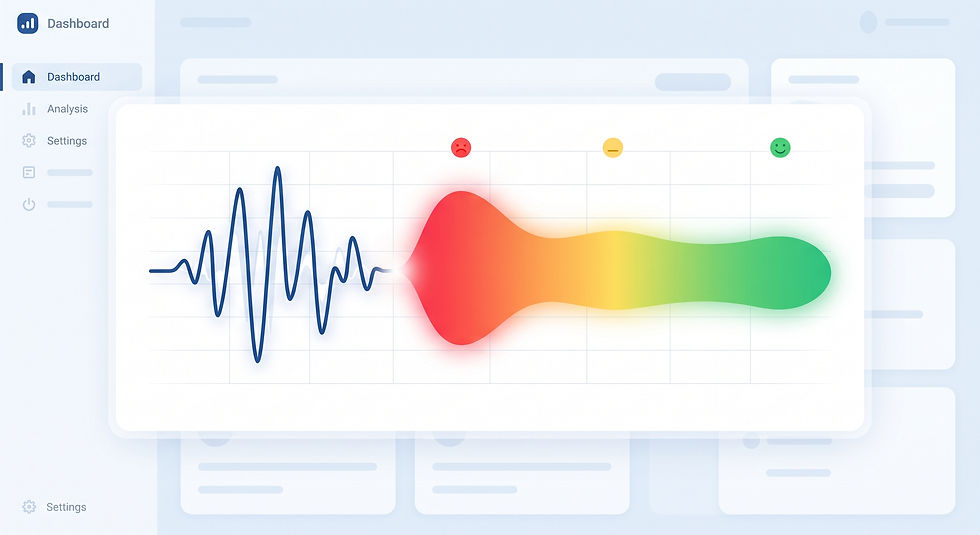
The output is typically a sentiment score for the call overall, plus a timeline showing where sentiment shifted — which matters more than the average score alone, since a call that starts cold and ends warm tells a very different story than one that starts warm and cools by the end.
Why the Timeline Matters More Than the Average
A call with an overall "neutral" sentiment score can hide two very different situations: a call that stayed flat throughout, or a call that started strongly positive and dropped sharply the moment pricing was mentioned. Averaging those two scenarios into a single number erases the most useful part of the data.
This is why the more useful conversation intelligence tools present sentiment as a timeline aligned to the transcript, not just a single summary score. A sharp dip at a specific moment is a much more actionable signal — it points a manager or rep directly to the exact point in the conversation worth reviewing, rather than leaving them to guess.
Turning Sentiment Data Into Deal Risk Signals
Sentiment pattern | What it often indicates | Suggested response |
Steady decline across the call | Growing disengagement or unaddressed concern | Follow up promptly to surface the unspoken objection directly |
Sharp dip at a specific topic (e.g., pricing) | A specific, identifiable friction point | Address that exact topic head-on in the next touchpoint |
Flat, low-energy throughout | Low genuine interest, possibly a low-fit lead | Re-qualify before investing further follow-up time |
Rising positivity toward the end | Growing buy-in, often paired with buying-signal language | Move quickly to next steps while momentum is high |
Aggregated across a full pipeline, these patterns become a genuine early-warning system: deals showing a declining sentiment trend across multiple touchpoints can be flagged as at-risk well before a prospect explicitly says they're no longer interested.
Where Sentiment Analysis Fits Alongside Other Signals

Sentiment on its own is a useful but incomplete picture — it works best combined with the other structured signals a conversation intelligence platform surfaces, such as talk ratio and flagged objections. A call with declining sentiment and a specific unresolved objection tells a much clearer story than either signal alone. Sentiment explains how a prospect feels; objection tracking explains why.
A Practical Way to Use This Without Over-Reading It
Sentiment scores are directional signals, not verdicts, and treating a single call's dip as a confirmed problem can lead a team astray — a prospect might simply have been distracted by something unrelated to the deal. A more reliable approach:
Look at trends across multiple calls with the same prospect, not a single data point in isolation.
Pair sentiment dips with the transcript moment they occurred, so the follow-up addresses something concrete rather than a vague feeling.
Use aggregate sentiment trends at the pipeline level to prioritize which deals need attention this week, rather than reviewing every call manually.
Avoid treating a single low score as disqualifying — some legitimately strong deals include a rocky call along the way.
Why This Matters More for Lean Teams
A well-staffed enterprise sales org might have a dedicated deal-desk function reviewing at-risk opportunities weekly. A small sales team rarely has that luxury — deal risk usually surfaces only when a prospect goes quiet or explicitly says no, by which point there's often little room left to recover the deal. Sentiment analysis compresses that discovery window: a declining trend across two or three calls is visible well before a prospect stops responding altogether, giving a rep an actual chance to address it while the deal is still live.
Frequently Asked Questions
Can sentiment analysis be wrong about how a prospect actually feels?
Yes, it's a strong directional signal, not a certainty. Tone can be affected by factors unrelated to the deal (a bad day, background noise, unfamiliarity with video calls), which is why trends across multiple calls are more reliable than any single score.
Does a negative sentiment score mean a deal is lost?
No. It means the deal is worth a closer look, ideally paired with the specific transcript moment that drove the dip, so the follow-up can address something concrete rather than reacting to a number alone.
How is this different from just asking a rep how a call felt?
A rep's gut read is valuable but inconsistent across a team and hard to track at scale. Sentiment analysis provides a consistent, comparable measure across every call and every rep, which makes pipeline-level patterns visible in a way individual impressions can't.


Comments