
Missed Call Follow-Up Automation for B2B Sales Teams
Author: Moeez Ullah Published Date: September 4, 2026

The Cost of a Call That Goes Unanswered
An inbound call to a B2B sales line represents a prospect who is, at that exact moment, ready enough to pick up the phone arguably the highest-intent touchpoint in the entire funnel. When that call goes unanswered and isn't followed up on quickly, the intent doesn't wait. A well-documented pattern across sales research is that lead response time correlates strongly with conversion rates, with the odds of qualifying a lead dropping sharply the longer follow-up is delayed. For a small B2B sales team without round-the-clock phone coverage, that's a real, recurring revenue leak — not an occasional inconvenience.
Missed call follow-up automation for B2B teams exists to close that gap systematically, rather than relying on a rep noticing a missed-call notification hours later.
Why Missed Calls Happen More Than Teams Realize
It's easy to assume missed calls are rare — an edge case rather than a real pattern. In practice, they tend to be more common than most sales leaders expect, for a few structural reasons:
Limited coverage hours: a small team can't staff phones around the clock, but inbound interest doesn't stop at 5 p.m.
Reps already on other calls: a single rep fielding inbound interest while also running outbound has no way to take two calls at once.
No clear ownership: when a call comes into a shared line, it's sometimes unclear whose job it is to call back, and the lead falls into a gap between reps.
Notification fatigue: a missed-call alert competes with dozens of other notifications a rep gets in a day, and easily gets buried.
None of these are signs of a poorly run team they're simply what happens when call volume outpaces available coverage, which is common for any growing small business.
What Automated Follow-Up Actually Does
Rather than relying on a rep to notice and manually call back, automated follow-up systems handle the gap immediately and consistently:
Instant notification with context: the rep (or a rotation of reps) is alerted the moment a call is missed, along with any available caller information.
Automated first-touch response: an automatic text or message acknowledging the missed call and setting expectations for a callback, sent within seconds rather than hours.
Structured callback queue: missed calls are logged and prioritized automatically rather than depending on someone remembering to check a call log.
Escalation logic: if the first available rep doesn't respond within a set window, the lead routes to the next available person rather than sitting unclaimed.
The goal isn't to replace a human callback with a bot conversation it's to make sure the gap between "call missed" and "human follow-up" is measured in minutes, not hours.
Comparing Manual vs. Automated Follow-Up
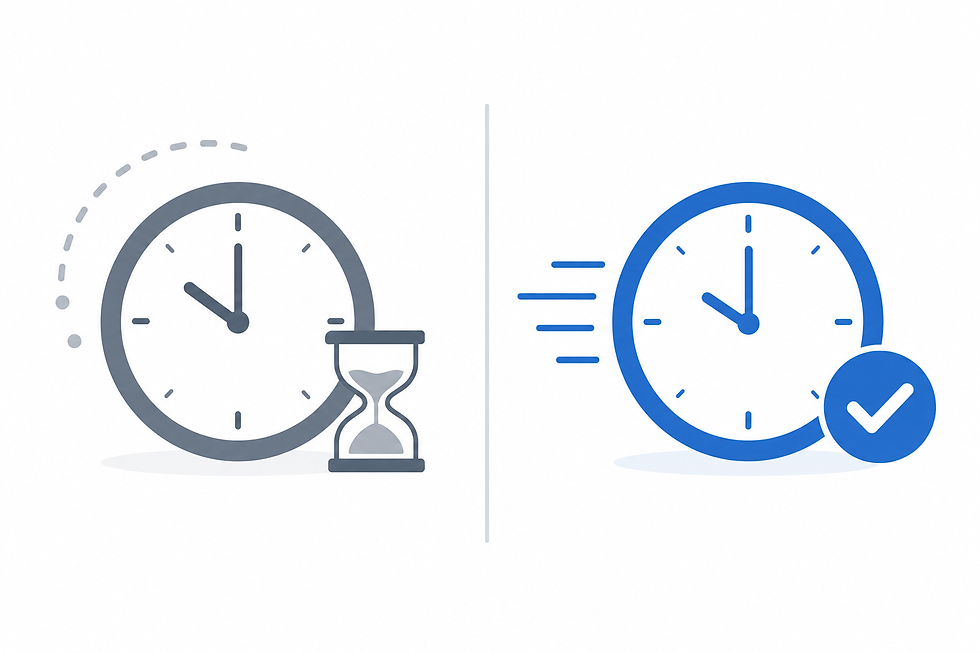
Factor | Manual follow-up | Automated follow-up |
Time to first response | Depends on when a rep notices | Seconds to minutes |
Consistency across reps | Varies by individual habits | Same process every time |
Lead ownership clarity | Can be ambiguous on shared lines | Assigned and tracked automatically |
Visibility into missed volume | Often unclear at a team level | Reportable — total missed calls, average response time |
Scalability as call volume grows | Breaks down past a certain volume | Holds steady regardless of volume |
Building a Missed-Call Response Process
For a small B2B sales team, a workable process doesn't need to be complex — it needs to be consistent:
Immediate acknowledgment: an automatic text sent the moment a call is missed, confirming someone will follow up shortly.
Clear ownership: a defined rotation or routing rule so it's never ambiguous who's responsible for the callback.
A response-time target: a concrete internal standard (for example, callback within 15 minutes during business hours) that the team can actually measure against.
Weekly visibility: a simple report on missed-call volume and average response time, so the team can see whether the process is actually holding up as call volume grows.
Where This Matters Most
Missed-call follow-up automation delivers the clearest return for teams with meaningful inbound call volume relative to headcount — companies running paid search or ads that drive phone inquiries, service businesses fielding direct customer calls, or any B2B team where a phone number is a primary contact channel rather than a secondary one. For teams that are almost entirely outbound-driven with minimal inbound volume, the same principle still applies, just with lower stakes, since the occasional missed inbound call still represents a warmer lead than most outbound touches.
A Note on Tone
Automated first-touch messages work best when they read as a genuine, brief acknowledgment rather than an obvious bot script — something closer to "Sorry we missed you, we'll call back shortly" than a generic automated notice. The goal is to buy time gracefully, not to substitute for the actual human follow-up that closes the loop.
Frequently Asked Questions
Does automating the first response feel impersonal to prospects?
Not when it's brief, honest about being an initial acknowledgment, and followed promptly by a real callback most prospects respond well to a fast, clear signal that someone is on it, rather than silence.
How fast does follow-up actually need to be to matter?
Faster is consistently better based on general lead-response research, though the practical target most small teams can realistically hold to is a callback within 15–30 minutes during business hours, with an automated acknowledgment sent immediately.
Is this only relevant for phone calls, or does it apply to other channels too?
The same response-time principle applies to missed messages on SMS or WhatsApp the channel matters less than making sure high-intent inbound contact never sits unanswered for hours.


Comments